In September 2025, the Emerging Professionals Working Groups (EPWG) of ICOMOS Germany, Belgium, and Portugal organised a Summer School in Munich, dedicated to interdisciplinary exchange and collaboration within ICOMOS and among all involved participants. The workshop was supported by the ICOMOS University Forum, the international EPWG, and the Technical University of Munich.
Under the key theme “Olympiapark Munich: Conceptualising a Conservation Management Plan (CMP)”, the program addressed the complex challenges surrounding the Olympiapark and its future conservation strategies. The City of Munich is currently initiating the inclusion of the Olympiapark on the UNESCO World Heritage List. Alongside its diverse landscape and architectural spaces and its rich culture of remembrance, contemporary challenges such as climate change and the sustainable transformation of the built environment are becoming increasingly significant. Over the course of four days, 20 international participants from various disciplines were introduced to the site through lectures and guided tours.
The Summer School opened at the Technical University of Munich. Experts from different fields who are actively involved in the nomination process shared their knowledge and experiences related to the Olympiapark. These presentations were complemented by guided tours led by representatives of the Olympiadorf community and the Architecture Museum. The central objective of the Summer School was to learn how to apply a key planning instrument — the Conservation Management Plan. Young professionals and students analyzed the park’s defining characteristics, focused on specific thematic fields, and developed strategies for the preservation of selected areas within the Olympiapark.
Elif Aktop, Flora Heckner, Başak Kalfa, Nataliia Koniaeva, Shramana Saha, and Grete Tiigiste explored the cultural landscape of the park. Concentrating on the landscape park, the group formulated recommendations aimed at safeguarding the spirit of the place.
Another major focus, the interweaving of narratives and commemorative culture, was examined by Aiya Duiseyeva, Annika Ruf, Emma Sweeney, Lisa Albrecht, and Yunseo Joung. Their work emphasized the importance of the site’s intangible heritage, as well as the tension between the democratic aspirations of the 1972 Olympic Games and the tragic events of the terror attack on 5 September 1972.
The special materiality and aesthetics of the Olympiapark were analyzed by H. Ilke Alatli, Elisabeth Ebert, Kevin Echeverry, Niko Grühl, and Clemens Hauf. They focused on how the iconic roof can be preserved and protected in the long term as a key component of the park’s living heritage.
Jonquille Clifford, Marine Nakaoka, Annukka Koeppen, and Flora Ledecq addressed the challenges posed by increasing tourism. They developed strategies for visitor management that aim to ensure a sustainable and long-term use of the park.
On the final day, all participants presented their results, demonstrating through innovative and creative approaches the wide range of aspects relevant to a CMP and the complexity of its development. The documentation and presentations of the Summer School are currently being prepared for publication.
Under the key theme “Olympiapark Munich: Conceptualising a Conservation Management Plan (CMP)”, the program addressed the complex challenges surrounding the Olympiapark and its future conservation strategies. The City of Munich is currently initiating the inclusion of the Olympiapark on the UNESCO World Heritage List. Alongside its diverse landscape and architectural spaces and its rich culture of remembrance, contemporary challenges such as climate change and the sustainable transformation of the built environment are becoming increasingly significant. Over the course of four days, 20 international participants from various disciplines were introduced to the site through lectures and guided tours.
The Summer School opened at the Technical University of Munich. Experts from different fields who are actively involved in the nomination process shared their knowledge and experiences related to the Olympiapark. These presentations were complemented by guided tours led by representatives of the Olympiadorf community and the Architecture Museum. The central objective of the Summer School was to learn how to apply a key planning instrument — the Conservation Management Plan. Young professionals and students analyzed the park’s defining characteristics, focused on specific thematic fields, and developed strategies for the preservation of selected areas within the Olympiapark.
Elif Aktop, Flora Heckner, Başak Kalfa, Nataliia Koniaeva, Shramana Saha, and Grete Tiigiste explored the cultural landscape of the park. Concentrating on the landscape park, the group formulated recommendations aimed at safeguarding the spirit of the place.
Another major focus, the interweaving of narratives and commemorative culture, was examined by Aiya Duiseyeva, Annika Ruf, Emma Sweeney, Lisa Albrecht, and Yunseo Joung. Their work emphasized the importance of the site’s intangible heritage, as well as the tension between the democratic aspirations of the 1972 Olympic Games and the tragic events of the terror attack on 5 September 1972.
The special materiality and aesthetics of the Olympiapark were analyzed by H. Ilke Alatli, Elisabeth Ebert, Kevin Echeverry, Niko Grühl, and Clemens Hauf. They focused on how the iconic roof can be preserved and protected in the long term as a key component of the park’s living heritage.
Jonquille Clifford, Marine Nakaoka, Annukka Koeppen, and Flora Ledecq addressed the challenges posed by increasing tourism. They developed strategies for visitor management that aim to ensure a sustainable and long-term use of the park.
On the final day, all participants presented their results, demonstrating through innovative and creative approaches the wide range of aspects relevant to a CMP and the complexity of its development. The documentation and presentations of the Summer School are currently being prepared for publication.
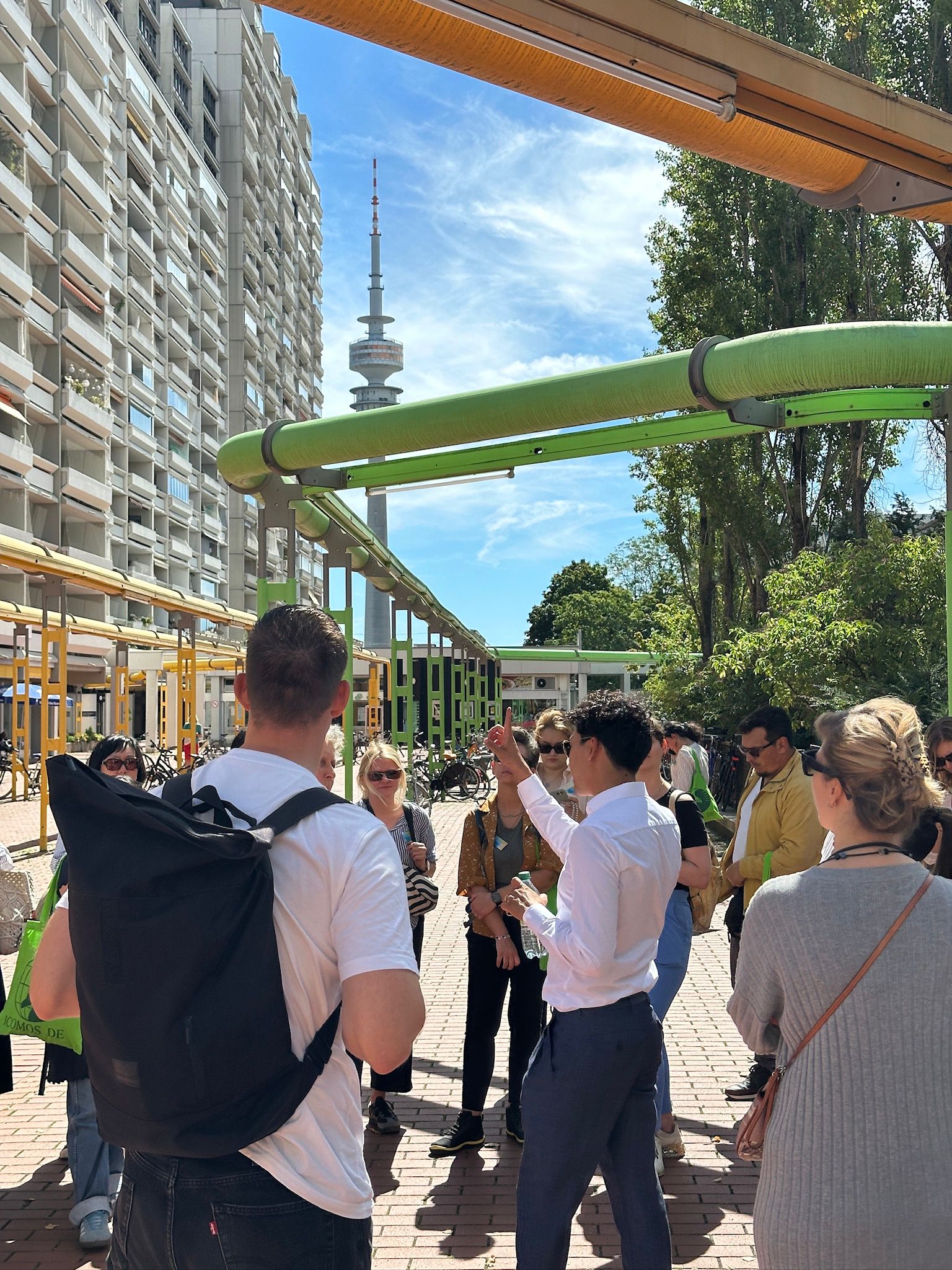
During the tour in the Olympic Village © Diana Polanski
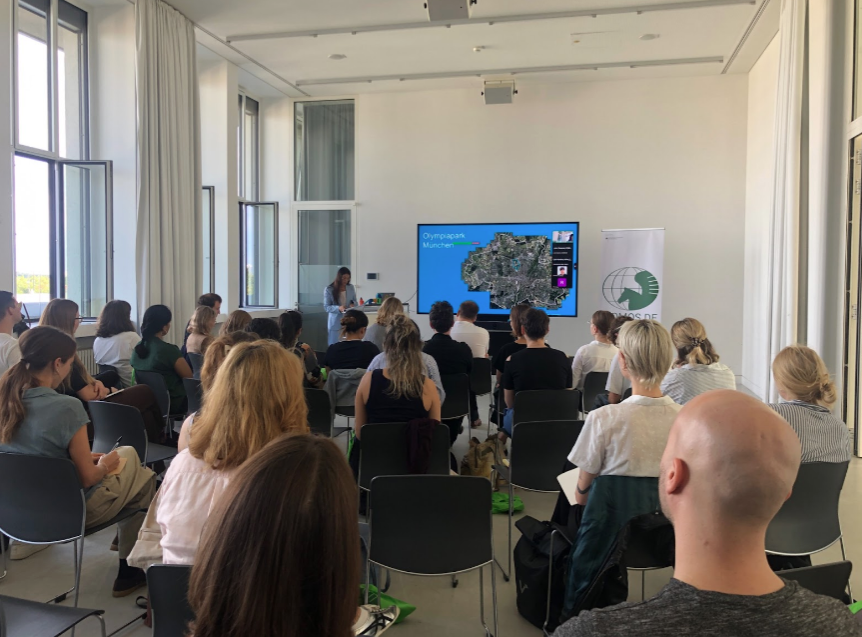
One of the introductory lectures at TU Munich © Diana Polanski